
Improving Treatment Outcomes in Sleep-Related Breathing Disorders: The Power of the Nose
Aug 16, 2026
Nasal breathing plays a central role in sleep quality, airway stability, nitric oxide production, and treatment outcomes.
When healthcare professionals discuss sleep-related breathing disorders, the conversation often centers around the airway, tongue, palate, tonsils, adenoids, sleep studies, CPAP, oral appliances, or surgery.
But one structure deserves far more attention: the nose.
In an Airway Circle Thursday Night Live presentation, Dr. Srinivas Kishore Sistla, an ENT and sleep apnea specialist, shared a powerful reminder for airway-focused professionals: nasal breathing is not optional. It is central to sleep quality, airway stability, nitric oxide production, craniofacial development, treatment success, and overall breathing function.
His message was clear: if we do not evaluate and support the nose, we may miss one of the most important factors influencing outcomes in sleep-related breathing disorders.
For dentists, orthodontists, myofunctional therapists, ENTs, sleep physicians, pediatric providers, speech-language pathologists, lactation professionals, and airway-focused clinicians, the nose must be part of the airway conversation.
Why the Nose Matters in Sleep-Related Breathing Disorders
The nose is the preferred pathway for breathing. It warms, humidifies, filters, and conditions the air before it reaches the lower airway.
But the nose does much more than that.
Dr. Sistla explained that the nose contributes significantly to airway resistance. When nasal resistance increases, breathing becomes less efficient and sleep-related breathing disorders may worsen.
Nasal breathing also helps support:
- Nitric oxide production
- Diaphragmatic breathing
- Upper airway stability
- Ventilation efficiency
- Sleep quality
- Sinus health
- Carbon dioxide regulation
- Craniofacial development
- Treatment tolerance with CPAP and oral appliances
- Daytime breathing function
In other words, the nose is not just the entrance to the airway. It is an active part of the breathing system.
Nasal Breathing vs. Mouth Breathing During Sleep
Many patients assume that mouth breathing is easier because it may feel easier while awake. But sleep changes the physiology.
Dr. Sistla emphasized that during sleep, oral breathing can become significantly more difficult than nasal breathing. When a patient switches from nasal breathing to mouth breathing at night, several problems may occur.
Mouth breathing can contribute to:
- Dryness of the upper airway
- Reduced mucosal surface tension
- Greater airway collapse
- Reduced nitric oxide delivery
- Reduced ventilation efficiency
- Increased carbon dioxide sensitivity
- Unstable breathing patterns
- Tongue collapse
- Poor sleep quality
When the throat becomes dry, the pharyngeal mucosa may become more likely to stick together. This can make the airway harder to reopen during sleep.
For airway professionals, this is an important reminder: mouth breathing is not a harmless adaptation. It can worsen airway instability.
Nitric Oxide: The Wonder Gas of Nasal Breathing
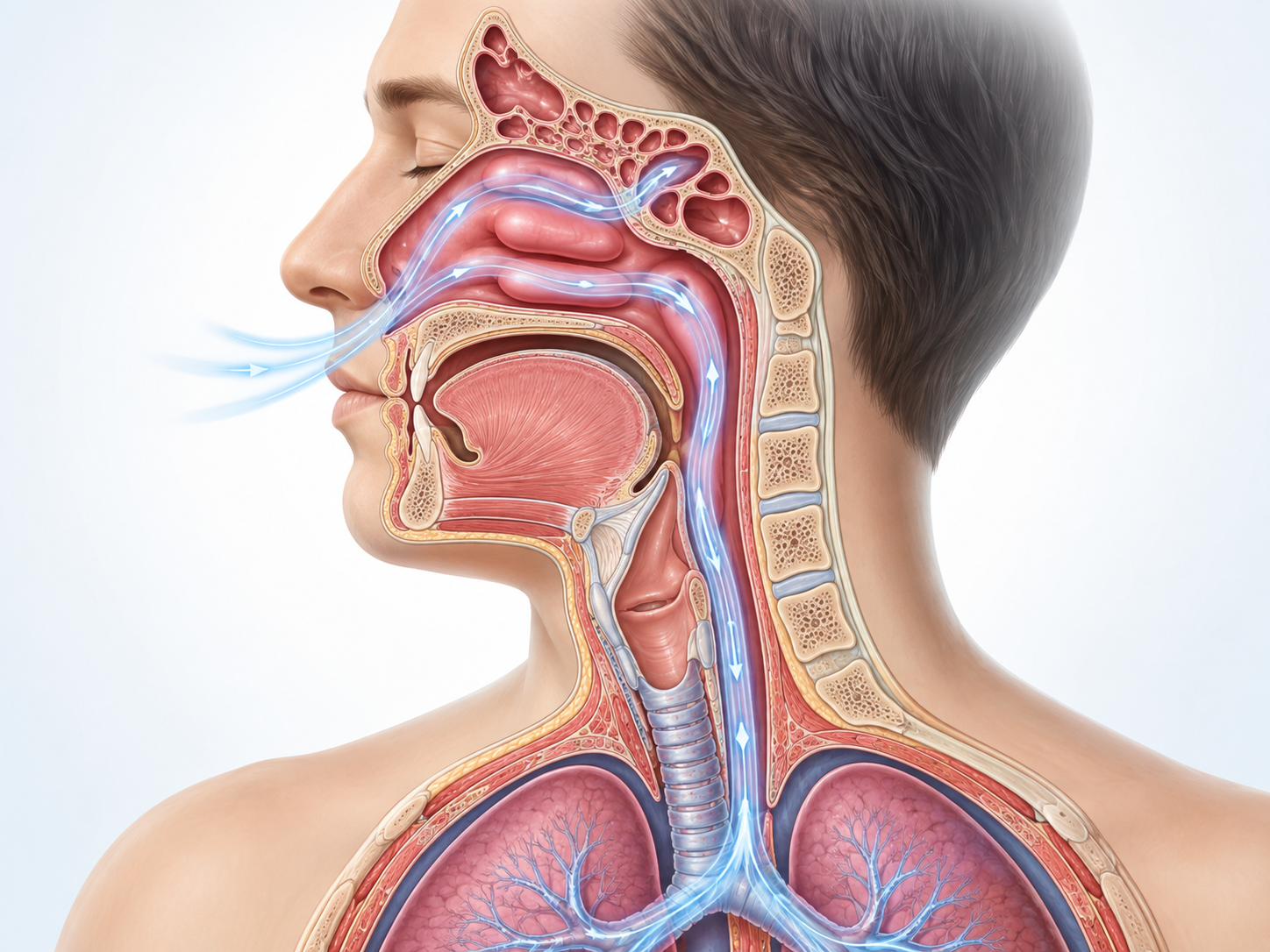
Nasal breathing helps carry nitric oxide from the sinuses into the lower airway, supporting respiratory efficiency and airway function.
One of the most important topics in Dr. Sistla’s presentation was nitric oxide.
Nitric oxide is produced in the paranasal sinuses and plays a vital role in respiratory, cardiovascular, immune, and neurological function. Nasal breathing helps carry nitric oxide from the sinuses into the lower airway.
When a patient breathes through the mouth, they lose much of this benefit.
Nitric oxide supports:
- Improved ventilation
- Better oxygen exchange
- Sinus health
- Antimicrobial defense
- Vascular regulation
- Respiratory efficiency
- Airway function
Dr. Sistla emphasized that nitric oxide is not produced in the same way with mouth breathing. This makes nasal breathing especially important for patients with sleep-related breathing disorders.
The Nose and Diaphragmatic Breathing
Nasal breathing supports better diaphragmatic breathing.
Dr. Sistla explained that when the diaphragm contracts properly, it helps create a downward pull on the mediastinum, trachea, and pharyngeal structures. This can help stiffen and stabilize the upper airway.
This is highly relevant in sleep-related breathing disorders because the pharynx is a collapsible tube. A stable breathing pattern and appropriate diaphragmatic function may help support airway patency.
For myofunctional therapists and breathing professionals, this reinforces the importance of teaching nasal breathing, diaphragmatic coordination, and functional breathing patterns together.
Nasal Obstruction and Sleep Quality
Nasal obstruction is common in patients with obstructive sleep apnea and sleep-related breathing disorders. It can reduce sleep quality, worsen symptoms, and affect treatment tolerance.
Dr. Sistla explained that nocturnal nasal obstruction may contribute not only to breathing disruption, but also to insomnia, daytime symptoms, reduced mental well-being, and reduced physical quality of life.
Patients with nasal obstruction may report:
- Poor sleep quality
- Snoring
- Mouth breathing
- Dry mouth
- Fragmented sleep
- Difficulty tolerating CPAP
- Difficulty with nasal pillows
- Daytime fatigue
- Brain fog
- Nasal congestion
- Restless sleep
Even when nasal treatment does not dramatically change the apnea-hypopnea index, it may improve how the patient feels, sleeps, and breathes.
This is clinically important because patients care about function, comfort, sleep quality, and quality of life, not only numbers on a sleep study.
Nasal Obstruction and Treatment Outcomes
One of the most practical parts of Dr. Sistla’s presentation was his explanation of how nasal obstruction affects treatment outcomes.
Nasal obstruction may reduce success with:
- CPAP therapy
- Nasal pillow interfaces
- Mandibular advancement devices
- Multilevel airway surgery
- Myofunctional therapy
- Daytime nasal breathing retraining
If the nose is blocked, patients may struggle to tolerate CPAP or may require higher pressures. They may also continue mouth breathing despite oral appliance therapy, expansion, or myofunctional therapy.
Dr. Sistla shared that nasal treatment can improve adherence to PAP therapy and may improve the effectiveness of other sleep apnea treatments.
For healthcare professionals, this means that nasal evaluation should not be an afterthought. It should happen early.
The Container and the Contents: A Better Way to Evaluate the Nose
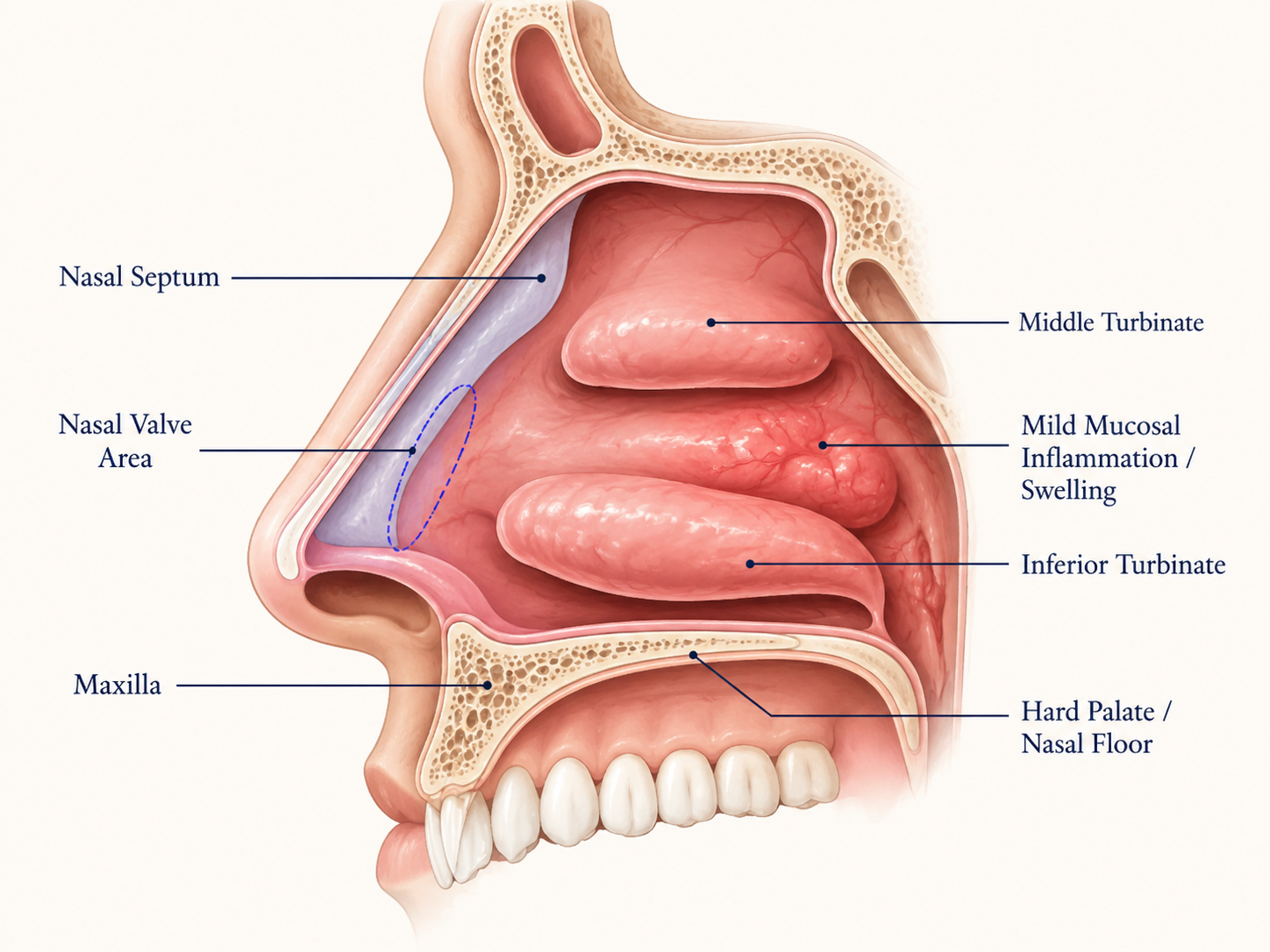
Evaluating nasal obstruction means looking at both the contents inside the nose and the skeletal container that supports nasal airflow.
Dr. Sistla introduced a helpful clinical framework: the container and the contents.
When evaluating nasal obstruction, clinicians should ask:
- Is the problem with the contents of the nose?
- Or is the problem with the container?
The contents include structures and conditions inside the nasal airway, such as:
- Deviated septum
- Turbinate hypertrophy
- Nasal valve collapse
- Septal swell body
- Polyps
- Synechiae
- Allergic rhinitis
- Non-allergic rhinitis
- Inflammation
The container refers to the skeletal framework around the nasal airway, including the maxilla and pyriform aperture. If the maxilla is underdeveloped or the nasal floor is narrow, the nose may be structurally constrained.
This distinction matters because treating only the contents may not fully help a patient whose container is too small.
For example, a patient may undergo septoplasty or turbinate reduction but still feel obstructed if the underlying maxillary structure is narrow.
The Roof of the Mouth Is the Floor of the Nose
One of the most important interdisciplinary points from Dr. Sistla’s lecture was this:
The roof of the mouth is the floor of the nose.
This is why dentists, orthodontists, myofunctional therapists, and ENTs must collaborate.
A high, narrow palate may be associated with a narrow nasal floor and limited nasal airway space. In these patients, nasal obstruction may not be only an ENT issue. It may also involve craniofacial development and maxillary deficiency.
This is especially important in children and adolescents with:
- High vaulted palate
- Transverse maxillary deficiency
- Mouth breathing
- Nasal obstruction
- Sleep-disordered breathing
- Crowding
- Tongue restriction
- Low tongue posture
- Snoring
- Poor CPAP tolerance in older patients
- Persistent symptoms after nasal treatment
Airway-focused orthodontics and maxillary expansion may play an important role in improving nasal airway function when the container is part of the problem.
Septal Deviation, Turbinates, and Septal Swell Body
Dr. Sistla discussed several important nasal structures that may contribute to obstruction.
A deviated septum can increase nasal resistance, especially when the deviation is significant. Turbinate hypertrophy can also reduce airflow and may fluctuate depending on allergy, inflammation, or environmental exposure.
He also highlighted the importance of the septal swell body, a structure on the septum that can become enlarged or inflamed and interfere with airflow through the middle meatus.
For clinicians outside ENT, this is a useful reminder that nasal obstruction is not always simple. A patient may have multiple contributing factors, including inflammation, anatomy, and skeletal limitations.
Allergy, Inflammation, and Nasal Breathing
Allergic rhinitis and non-allergic rhinitis are important contributors to nasal obstruction.
Dr. Sistla emphasized that allergy treatment should be taken seriously. In some patients, medical management may include nasal rinses, intranasal corticosteroids, allergy evaluation, environmental management, or other ENT-guided care.
He explained that a short trial of nasal steroid spray may not be enough. In some cases, a longer and more appropriate medical trial may be needed to truly evaluate response.
For airway professionals, this matters because untreated inflammation may continue to drive mouth breathing, sleep disruption, and poor treatment outcomes.
Nasal Rinses: A Simple but Powerful Tool
One of the strongest practical recommendations from Dr. Sistla’s presentation was the importance of nasal rinsing.
He emphasized that nasal rinses are strongly supported in ENT guidelines and can be helpful for clearing the nasal passages, reducing inflammatory load, and improving the effectiveness of nasal medications.
When using intranasal steroid sprays, rinsing before the spray may help improve delivery.
For patients with chronic nasal congestion, allergies, mouth breathing, or sleep-related breathing disorders, nasal hygiene can be an important foundational step.
As always, patients should follow age-appropriate guidance and medical recommendations, especially for infants, neurologically compromised patients, or anyone at risk of aspiration.
Tonsils, Adenoids, and the Bigger Airway Picture
Dr. Sistla also discussed tonsils and adenoids as part of the broader airway picture.
Enlarged tonsils and adenoids may reflect inflammation, allergy, reflux, sleep-related breathing disorder, or other underlying drivers. In some children, surgery may be necessary, especially when obstruction is severe and the child is choking, gasping, or experiencing significant sleep disruption.
However, he emphasized the importance of understanding why the tonsils or adenoids are enlarged.
Possible contributors may include:
- Allergic rhinitis
- Reflux
- Inflammation
- Dietary factors
- Sleep-related breathing disorder
- Mouth breathing
- Chronic nasal obstruction
This does not mean surgery should always be delayed. It means clinicians should avoid a one-size-fits-all approach and evaluate the child comprehensively.
Septal Deviation in Children
A common question in airway care is whether a deviated septum can or should be corrected in children.
Dr. Sistla explained that when septal deviation is a major cause of obstruction, it should not automatically be ignored. In some children, leaving a significant obstruction untreated may perpetuate mouth breathing and abnormal craniofacial growth patterns.
He emphasized that correcting the septum alone is not enough. If the child continues mouth breathing and does not receive functional support, the surgery may not achieve the desired outcome.
This is where collaboration with myofunctional therapy becomes essential.
Why Myofunctional Therapy Matters After Nasal Treatment
Dr. Sistla repeatedly emphasized that nasal surgery or nasal treatment alone does not automatically restore nasal breathing.
If a patient has been mouth breathing for years, the tongue, lips, jaw, and breathing pattern may need retraining. The nose may be open, but the habit and function may remain dysfunctional.
Myofunctional therapy can help support:
- Nasal breathing habits
- Tongue posture
- Lip seal
- Diaphragmatic breathing
- Oral rest posture
- Swallowing patterns
- Reduction of mouth breathing
- Post-surgical functional adaptation
- Better long-term airway outcomes
This is especially important after septoplasty, turbinate treatment, adenoidectomy, tonsillectomy, maxillary expansion, or other airway interventions.
The goal is not just to open the airway. The goal is to help the patient use it.
Clinical Questions for Healthcare Professionals
When working with patients who have sleep-related breathing disorders, clinicians should consider asking:
- Can the patient breathe comfortably through the nose during the day?
- Does the patient mouth breathe at night?
- Does the patient wake with dry mouth?
- Is there chronic nasal congestion?
- Does the patient have allergies?
- Has the patient had recurrent sinus or nasal issues?
- Does the patient tolerate CPAP or nasal pillows?
- Is there a high vaulted palate or narrow maxilla?
- Is the roof of the mouth narrow, indicating a potentially narrow nasal floor?
- Are tonsils or adenoids enlarged?
- Is there a history of reflux?
- Has nasal obstruction been evaluated by an ENT?
- Does the patient need nasal hygiene, allergy care, expansion, surgery, myofunctional therapy, or a combination?
These questions help move treatment planning from symptom management to comprehensive airway care.
Key Takeaways for Healthcare Professionals
- The nose plays a critical role in sleep-related breathing disorders.
- Nasal breathing supports nitric oxide production, airway stability, diaphragmatic breathing, and sleep quality.
- Mouth breathing during sleep can worsen airway collapse and reduce respiratory efficiency.
- Nasal obstruction can independently affect quality of life and may contribute to resistant hypertension.
- Nasal obstruction can reduce CPAP tolerance, oral appliance effectiveness, and surgical outcomes.
- Clinicians should evaluate both the contents of the nose and the container of the nasal airway.
- The roof of the mouth is the floor of the nose, making orthodontic and ENT collaboration essential.
- Nasal rinses are a simple but powerful tool for nasal hygiene and inflammation support.
- Tonsils and adenoids should be evaluated within the broader context of inflammation, allergy, reflux, sleep, and airway function.
- Myofunctional therapy is essential for helping patients transition from mouth breathing to nasal breathing after structural or medical treatment.
The Airway Circle Perspective

Better airway outcomes happen when ENTs, dentists, orthodontists, myofunctional therapists, and sleep providers collaborate.
At Airway Circle, we believe that airway care must be collaborative, functional, and comprehensive.
Dr. Srinivas Kishore Sistla’s presentation reminds us that the nose is not just an anatomical structure. It is central to breathing physiology, sleep quality, craniofacial development, nitric oxide production, and treatment outcomes.
For dentists, orthodontists, myofunctional therapists, ENTs, sleep physicians, and other airway professionals, the future of airway care depends on better collaboration.
- The ENT must look beyond the nose.
- The dentist must understand the nasal floor.
- The orthodontist must consider airway development.
- The myofunctional therapist must support nasal breathing function.
- And every provider must ask: is this patient truly able to breathe through the nose?
Final Thoughts
Improving treatment outcomes in sleep-related breathing disorders requires us to respect the power of the nose.
When nasal obstruction is ignored, patients may struggle with CPAP, oral appliances, surgery, sleep quality, mouth breathing, and long-term function.
When the nose is evaluated properly, and when medical, surgical, orthodontic, and myofunctional care are integrated, patients have a better chance at meaningful improvement.
The secret of life may truly be right under the nose.
And in airway care, the nose should never be overlooked.
Need Guidance With Airway, Nasal Breathing, or Myofunctional Therapy?
Finding the right support for airway health, nasal breathing, sleep, tongue function, oral restrictions, or breathing dysfunction does not have to feel overwhelming. With the right guidance, patients and providers can better understand the clinical picture and explore the next best steps.
Whether care involves myofunctional therapy, ENT evaluation, nasal hygiene, airway-focused dentistry, orthodontic expansion, sleep testing, tongue-tie assessment, or referrals to the right provider, the goal is to improve function and quality of life.
Your journey to better breathing, better sleep, and better oral function starts here.