
Sensory Processing and Airway Health: Why Occupational Therapy Belongs on the Interdisciplinary Team
Jul 19, 2026
Airway health is connected to sensory processing, motor planning, posture, breathing, and regulation.
Airway health is never just about the airway.
Patients who struggle with mouth breathing, sleep-disordered breathing, tongue dysfunction, feeding challenges, oral restrictions, or myofunctional disorders may also present with sensory processing difficulties, poor motor planning, postural challenges, attention concerns, emotional dysregulation, and developmental delays.
For healthcare professionals working in airway health, this matters.
In an Airway Circle Thursday Night Live presentation, occupational therapist Dave Pilon shared an important clinical perspective on how sensory processing, motor planning, occupational therapy, and airway-focused care intersect.
His message was clear: when patients are not progressing as expected, it may not be because they are unwilling, unmotivated, or noncompliant. They may lack the sensory, motor, or developmental foundation needed to access the therapy being provided.
This is where occupational therapy can become an essential part of the airway team.
Why Sensory Processing Matters in Airway Health

Oral function depends on body awareness, postural control, coordination, and a regulated nervous system.
Sensory processing is the neurological process that allows the body to receive, interpret, and respond to sensory information.
This includes information from the familiar senses, such as touch, taste, smell, sight, and hearing. It also includes the vestibular system, which helps with balance and movement, and the proprioceptive system, which helps the brain understand body position and force.
For airway and myofunctional therapy patients, these systems matter because oral function requires body awareness, coordination, postural control, regulation, and motor planning.
A patient may need to:
- Feel where the tongue is resting
- Imitate oral movements
- Coordinate nasal breathing
- Maintain lip seal
- Chew effectively
- Swallow with proper patterning
- Sit upright with postural stability
- Tolerate touch around the face and mouth
- Follow verbal and visual directions
- Practice repetitive exercises
These skills require more than instruction. They require a nervous system that can process information, stay regulated, and build new motor patterns.
Sensory Modulation vs. Sensory Discrimination
Dave Pilon emphasized the importance of understanding two key components of sensory processing: sensory modulation and sensory discrimination.
Sensory modulation refers to the brain’s ability to regulate responses to sensory input. It helps determine whether a person remains calm, alert, overwhelmed, shut down, or dysregulated.
A patient with sensory modulation challenges may be easily overwhelmed by:
- Touch around the mouth or face
- Dental appointments
- Bright lights
- Noise
- Textures
- Clothing tags
- Toothbrushing
- Certain foods
- Oral tools
- Therapy demands
When a patient is in sensory overload, learning becomes harder. They may not be able to process language well, imitate movements, follow cues, or participate in therapy successfully.
Sensory discrimination, on the other hand, involves the brain’s ability to interpret and understand sensory information. It helps the patient know where the body is in space and how to move with precision.
A patient with sensory discrimination challenges may struggle to know:
- Where the tongue is in the mouth
- How much pressure to use
- How to coordinate breathing and movement
- How to imitate facial or oral exercises
- How to sit upright
- How to use both sides of the body
- How to organize motor movements
This is highly relevant for myofunctional therapy, feeding therapy, speech therapy, airway dentistry, and orthodontic care.
Motor Planning and Myofunctional Therapy
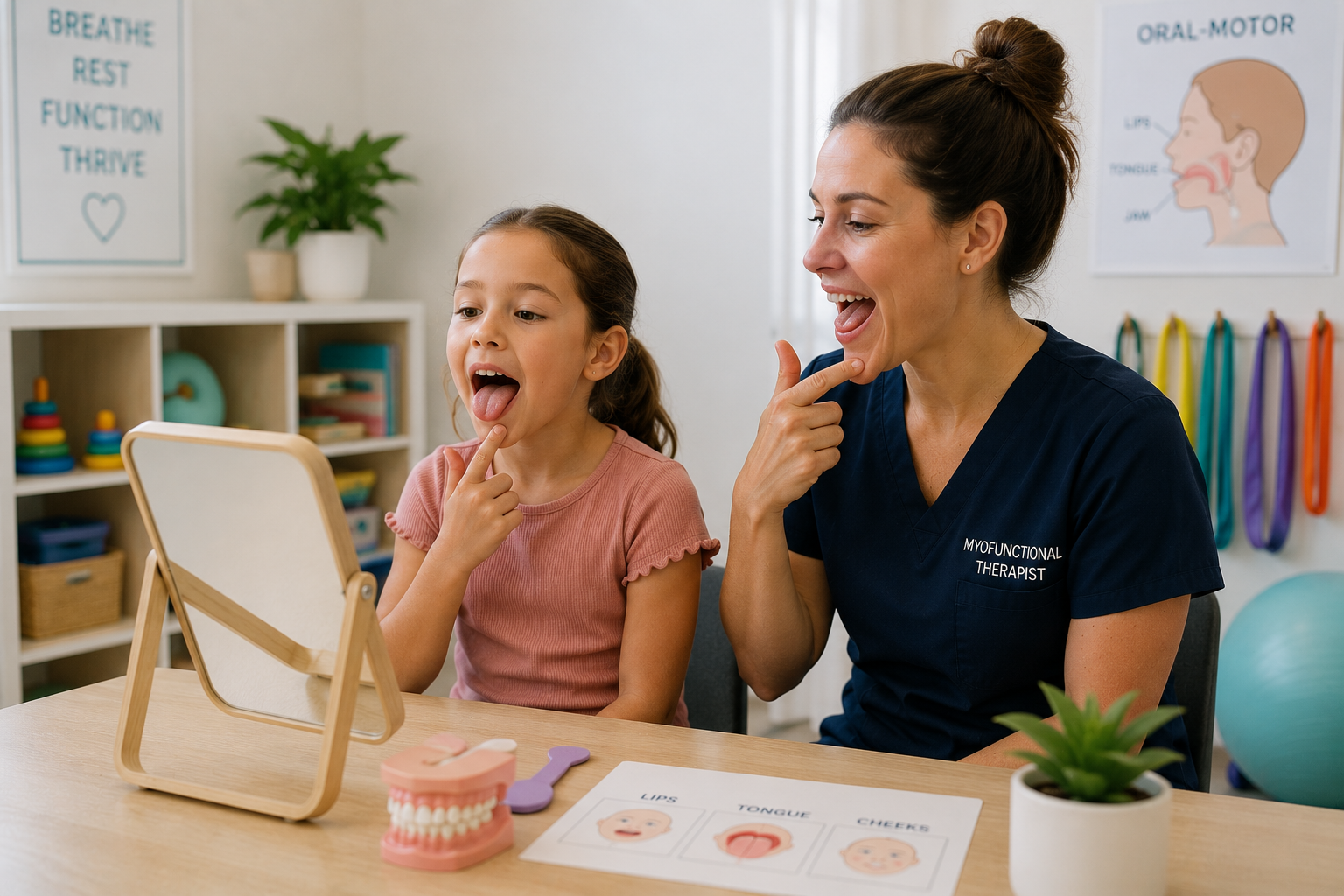
Motor planning helps patients organize new patterns for breathing, chewing, swallowing, tongue posture, and oral function.
Motor planning is the ability to organize and carry out movements. It is essential for everything from reaching for a cup to chewing, swallowing, speaking, breathing, and performing oral motor exercises.
In myofunctional therapy, patients are often asked to learn new patterns. They may need to change how they breathe, where they rest their tongue, how they swallow, how they chew, or how they use their lips and jaw.
But if the patient has difficulty with motor planning, even simple instructions may feel overwhelming.
For example, a provider may ask a patient to place the tongue on the spot, suction the tongue to the palate, maintain nasal breathing, or complete a series of facial exercises. If the patient cannot feel the movement, organize the sequence, or tolerate the sensory input, progress may be limited.
This is not defiance. It is a clinical clue.
As Dave shared, what we see in the body may also show up in the mouth. Whole-body motor planning and oral motor planning are connected.
Why Some Patients Struggle to Progress
Many airway professionals have experienced the frustration of working with a patient who seems stuck.
The provider may be using appropriate protocols. The exercises may be correct. The referrals may be appropriate. The education may be clear.
Yet the patient still struggles.
- They may not be able to imitate movements.
- They may avoid oral exercises.
- They may have difficulty sitting still.
- They may become silly, distracted, or dysregulated.
- They may gag easily.
- They may resist touch near the mouth.
- They may have poor posture.
- They may fatigue quickly.
- They may not follow through at home.
- They may appear anxious, impulsive, or inattentive.
In some cases, the missing piece may be sensory processing, motor planning, or developmental readiness.
This is why occupational therapy can be so valuable within the interdisciplinary airway model.
The Role of Occupational Therapy on the Airway Team
Occupational therapists are trained to assess how the nervous system, sensory processing, motor skills, regulation, development, and daily function interact.
In the airway world, an OT may help evaluate and support:
- Sensory processing
- Self-regulation
- Body awareness
- Motor planning
- Postural control
- Coordination
- Feeding readiness
- Toothbrushing tolerance
- Oral sensory sensitivity
- Attention and participation
- Daily routines
- Developmental skills
- Family education
When an OT is part of the team, the patient may be better prepared to participate in myofunctional therapy, feeding therapy, dental care, orthodontic care, speech therapy, or tongue-tie-related treatment.
This does not mean every airway patient needs occupational therapy. It means providers should know when to consider it.
Clinical Signs That May Indicate an OT Referral
Airway-focused providers may consider an occupational therapy referral when a patient presents with:
- Difficulty tolerating touch around the face or mouth
- Strong reactions to toothbrushing
- Gagging with oral tools or textures
- Extreme food texture preferences
- Difficulty sitting still during therapy
- Poor body awareness
- Clumsiness or frequent bumping into objects
- Difficulty imitating movements
- Trouble following multi-step directions
- Poor posture or low endurance
- Sensory-seeking behaviors
- Sensory avoidance
- Emotional dysregulation
- Difficulty with transitions
- Persistent toe walking
- Delayed motor skills
- Attention challenges that interfere with therapy
- Poor participation despite good rapport and instruction
These signs do not automatically mean the patient has a sensory processing disorder. They do indicate that further assessment may be helpful.
Sensory Regulation and Therapy Readiness
One of the most important clinical concepts from this presentation is that patients learn best when they are regulated.
If a child or adult is overstimulated, anxious, shut down, or in fight-or-flight mode, the brain is not in an ideal state for learning new motor patterns.
This matters for myofunctional therapy because therapy often requires attention, body awareness, imitation, repetition, and integration of new habits.
A regulated nervous system supports:
- Better attention
- Better imitation
- Better language processing
- Better body awareness
- Better participation
- Better motor learning
- Better carryover at home
This is why sensory regulation is not a side issue. It can directly influence treatment outcomes.
The Connection Between the Body and the Mouth
Airway professionals often focus on the mouth, tongue, jaw, lips, palate, and breathing patterns. Occupational therapists often focus on whole-body development, sensory processing, regulation, posture, motor planning, and functional participation.
These two perspectives complement each other.
The mouth is not separate from the body. Oral function depends on the nervous system, posture, breathing, tone, coordination, sensory input, and motor learning.
- A child who cannot organize their body may also struggle to organize their mouth.
- A patient who cannot tolerate touch may struggle with oral exercises.
- A patient with poor postural stability may compensate during breathing, chewing, swallowing, or speech.
- A patient with poor body awareness may struggle to feel tongue placement or lip posture.
This is why collaboration matters.
Occupational Therapy, Feeding, and Airway Health
Feeding challenges are common in children with airway and myofunctional concerns. Some children have restricted diets, difficulty chewing, poor oral awareness, texture aversions, gagging, low tone, mouth breathing, poor endurance, or difficulty coordinating suck-swallow-breathe patterns.
An OT can help evaluate the sensory and motor components of feeding and determine whether the child’s challenges are related to sensory modulation, motor planning, posture, regulation, oral sensory input, or broader developmental factors.
For patients with tongue tie, mouth breathing, sleep-disordered breathing, or oral dysfunction, this can be especially helpful.
Feeding is not just about the mouth. It is a whole-body activity.
The Importance of Multidisciplinary Care
Dave Pilon emphasized that collaboration is essential. Airway health is too complex for one provider to manage alone.
A strong interdisciplinary airway team may include:
- Myofunctional therapists
- Occupational therapists
- Speech-language pathologists
- Airway-focused dentists
- Orthodontists
- ENTs
- Sleep physicians
- Lactation consultants
- Physical therapists
- Feeding therapists
- Bodyworkers
- Pediatricians
- Mental health providers
Each provider brings a different lens. The more complete the lens, the better the clinical decision-making.
For healthcare professionals, the key is knowing when a patient needs another layer of support.
Key Takeaways for Healthcare Professionals
- Sensory processing can affect participation in airway, feeding, dental, orthodontic, and myofunctional therapy.
- Sensory modulation affects regulation, attention, tolerance, and therapy readiness.
- Sensory discrimination affects body awareness, oral awareness, motor planning, and imitation.
- Motor planning is essential for learning new breathing, chewing, swallowing, and tongue posture patterns.
- Patients who appear noncompliant may actually be dysregulated, overwhelmed, or unable to access the motor plan being requested.
- Occupational therapy can help patients build the sensory, motor, and regulatory foundation needed for better outcomes.
- Collaboration between OTs, myofunctional therapists, dentists, speech therapists, and airway providers can improve care for complex patients.
The Airway Circle Perspective

Complex airway cases often improve when providers collaborate across breathing, sleep, oral function, sensory processing, feeding, and development.
At Airway Circle, we believe airway health requires a whole-person, interdisciplinary approach. Breathing, sleep, oral function, feeding, posture, sensory processing, development, and nervous system regulation are all connected.
Dave Pilon’s presentation reminds us that when a patient is struggling, we should ask better clinical questions.
- Can this patient feel what we are asking them to do?
- Can they tolerate the sensory input?
- Can they imitate the movement?
- Can they stay regulated enough to learn?
- Do they have the postural and motor foundation needed for oral function?
- Do they need support from an occupational therapist?
These questions can help providers move beyond frustration and toward more effective collaboration.
Final Thoughts
Sensory processing is an important consideration in airway health, especially for patients who struggle with myofunctional therapy, feeding therapy, dental care, oral exercises, motor planning, regulation, or participation.
Occupational therapy does not replace myofunctional therapy, airway dentistry, speech therapy, orthodontics, or medical care. It complements them.
When healthcare professionals understand the role of sensory processing and motor planning, they can identify barriers earlier, refer more appropriately, and help patients access the care they need.
The future of airway health is interdisciplinary.
And occupational therapy deserves a seat at the table.
Need Guidance With Airway, Sleep, or Myofunctional Therapy?
Finding the right support for airway health, breathing, sleep, tongue function, sensory challenges, feeding concerns, or oral restrictions does not have to feel overwhelming. With the right guidance, patients and providers can better understand the clinical picture and explore the next best steps.
Whether care involves myofunctional therapy, airway-focused dentistry, occupational therapy, feeding therapy, sleep evaluation, tongue-tie assessment, or referrals to the right provider, the goal is to improve function and quality of life.
Your journey to better breathing, better sleep, and better oral function starts here.